
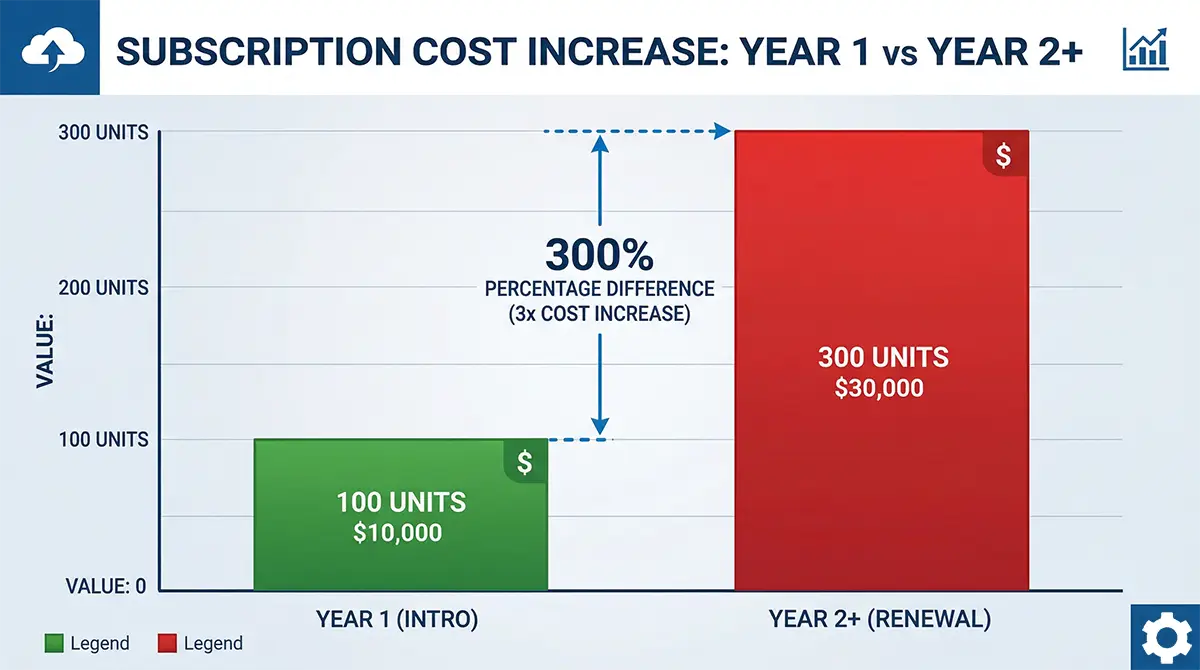
Web hosting pricing is intentionally fragmented, often leading to a 300% to 500% increase during the first renewal cycle for agency accounts. To protect service margins in 2026, agencies must calculate the Total Cost of Ownership (TCO) by accounting for per-user licensing fees, backup storage tiers, and the “cPanel tax” that introductory rates deliberately omit.
🚀 Key Takeaways
- The “Teaser Rate” Trap: Introductory pricing for agencies is a loss leader; real profitability is only visible after the Renewal Rate kicks in at month 13 or 36.
- Licensing Inflation: In 2026, many hosts have shifted to “Per-Account” billing for control panels, meaning adding one small client site can trigger a $30/month tier jump.
- Hidden Infrastructure Fees: Beyond the base server cost, agencies are often blindsided by Egress Fees and premium support surcharges that aren’t included in the headline price.
The Anatomy of the Teaser Rate Strategy
Most web hosting companies use a “Low-Entry, High-Exit” pricing model to lock in agency partners who find migration too cumbersome to leave. This strategy relies on the fact that once an agency has 50+ clients on a server, the labor cost of moving them exceeds the cost of a 400% price hike. According to recent data from HostingTribunal, the gap between intro and renewal rates has widened significantly in 2026.
Understanding the Overselling Ratio
Providers offering “Unlimited” agency plans for $20/month rely on a high Overselling Ratio. They bet that only 5% of your clients will use their allocated resources simultaneously. For an agency, this is a massive risk. If three of your clients run marketing campaigns at once, the host will throttle your entire account, forcing an “emergency upgrade” to a plan that costs triple your original budget.
The Lifecycle of an Agency Contract
Typically, an agency signs up for a 3-year term to get the lowest possible price. However, the hosting renewal cost is calculated based on the “Regular Rate” at that future date, not the rate at the time of signing. In a high-inflation tech economy, this makes long-term financial forecasting nearly impossible without a price-lock guarantee in your Service Level Agreement (SLA).
Identifying Hidden Charges in Your Monthly Bill
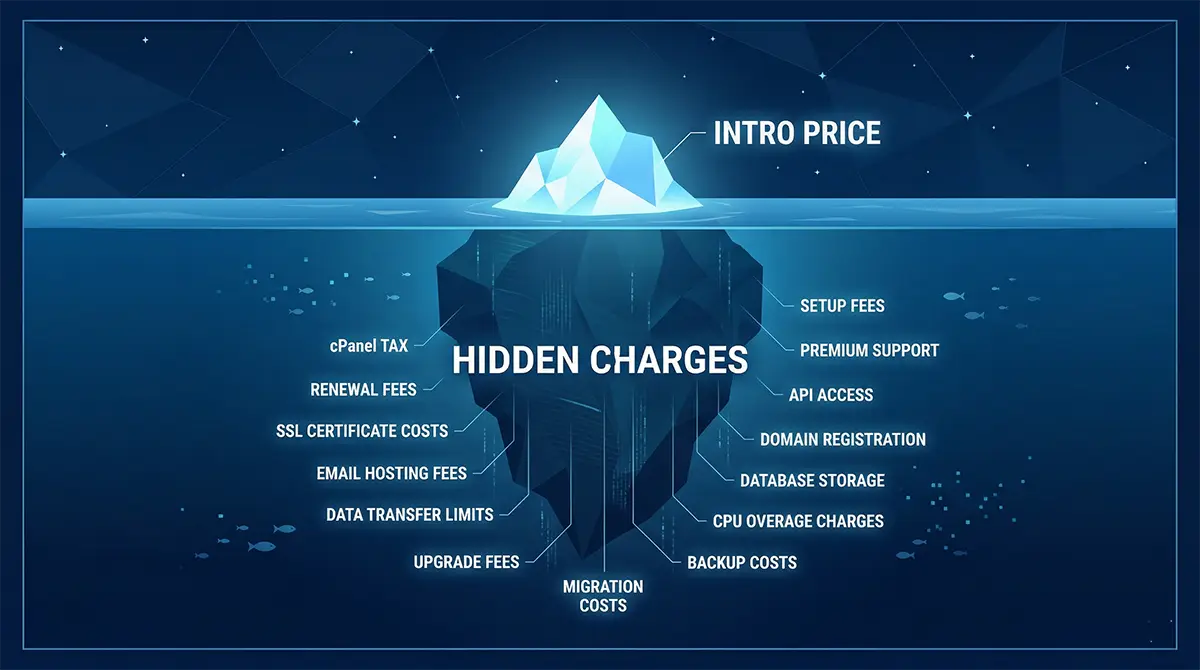
Modern hosting invoices are increasingly “SaaSified,” where features that were once standard are now billed as separate line items. For an agency efficiency lead, auditing these “micro-services” is the fastest way to recover lost margin. In 2026, we see a rise in “Security Surcharges” and “Carbon Offset Fees” that are rarely mentioned in the initial checkout flow.
The Evolution of the “cPanel Tax”
The industry-wide shift toward per-user licensing—often called the “cPanel Tax”—has revolutionized web hosting pricing explained to the detriment of agencies. If you host 100 small sites, you are no longer paying for the server hardware; you are paying a massive software tax to the control panel provider. According to the cPanel Official Partner Pricing, tiers are now strictly capped, making the “Gold” and “Platinum” tiers a significant portion of an agency’s overhead.
Egress Fees and Data Transfers
While “Inbound Data” is usually free, Egress Fees (the cost of data leaving the server to the user) can vary wildly. If your agency manages video-heavy sites or high-traffic e-commerce stores, these fees can quietly double your bill. Checking for membership in the Bandwidth Alliance can help agencies find hosts that waive these specific hidden charges.
Premium Support Upselling
Many “Agency-Specific” hosting plans include “Priority Support.” However, in 2026, “Priority” often just means “Standard” while the basic tier is intentionally slowed down. If your team spends 5 hours a month waiting for support tickets, that labor cost must be added to your hosting TCO calculation.
Total Cost of Ownership: A 2026 Agency Audit
To truly understand what you are paying, you must move beyond the “Price Per Month” and calculate the cost per client site including all variables. An agency managing 50 sites might think they are paying $150/month, but after adding security patches, backups, and licensing, the real cost is often closer to $450. Hetzner’s 2026 Price Adjustments highlight how energy surcharges are also becoming a standard variable in global hosting bills.
The Agency Infrastructure Budget (Sample Audit)
| Expense Category | Advertised Cost (Monthly) | Reality/Hidden Cost (Monthly) |
|---|---|---|
| Base VPS/Cloud Server | $80.00 | $110.00 (Due to Energy/IP Surcharge) |
| Control Panel License | Included (Starter) | $45.00 (Tier jump after 30 sites) |
| Off-site Backups | \"Free\" | $35.00 (Over 50GB storage limit) |
| SSL Certificates | Free (Let's Encrypt) | $10.00 (Management fee per cert) |
| Premium CDN | $0.00 | $25.00 (For Egress/WAF features) |
| Total Agency Spend | $80.00 | $225.00 |
The “White-label” Markup Trap
Many agencies use white-label reseller hosting. While this simplifies billing, the markup is often 200% higher than managing the same resources on a raw cloud provider like AWS or Google Cloud. The “convenience fee” for a white-label dashboard is where most agencies lose their competitive edge in pricing.
Strategies to Mitigate Renewal Shock
The most efficient agencies in 2026 are moving toward “Decoupled Infrastructure” to regain control over their margins. By separating the hosting hardware from the management layer, you can swap providers without a total site migration. This prevents being held hostage by a single provider’s 400% renewal increase.
Leveraging Multi-Cloud Redundancy
Instead of putting all clients on one massive server, top-tier agencies distribute sites across multiple “Availability Zones.” This allows for High-Availability (HA) Premium services to be sold to clients as an upsell, rather than an internal agency expense. It also provides leverage during price negotiations; if one host raises rates, you can shift future growth to a competitor instantly.
Automated Resource Auditing
Using API-driven tools to monitor CPU and RAM utilization allows you to see if you are “Over-provisioning.” If your server is running at 20% capacity, you are throwing away 80% of your budget. Efficient agencies “right-size” their servers every quarter, ensuring they aren’t paying for “ghost resources” that aren’t serving client traffic.
Frequently Asked Questions
01 What is the average hosting renewal cost for agencies?
In 2026, the average renewal cost is 3x to 5x the introductory rate. For a standard VPS, an intro rate of $20 usually renews at $65–$85 per month. Always check the "Terms of Service" for the "Regular Rate" before signing.
02 Why do hosts charge for SSL if Let's Encrypt is free?
While the certificate is free, hosts often charge a "Management" or "Installation" fee. They justify this by providing automated renewal monitoring and technical support, though many premium hosts include this at no extra cost.
03 How can I avoid the "cPanel Tax"?
Many agencies are switching to alternative control panels like Siteric, RunCloud, or SpinupWP. These tools allow you to manage multiple servers and sites for a flat monthly fee, decoupling the software cost from the number of client accounts.
04 What are "Egress Fees" in 15 words or less?
The cost a hosting provider charges for data leaving their network to reach your visitors.
05 Is "Unlimited Hosting" real for agencies?
No. All servers have physical limits on CPU, RAM, and IOPS. "Unlimited" is a marketing term that essentially means "unmetered until you become a nuisance to our other customers."