

A domain name is your startup’s digital address, while web hosting is the physical server space storing your website files. Bootstrapped Indian founders must understand this technical difference to build highly scalable, cost-effective digital infrastructure without falling into restrictive vendor lock-ins.
Engineering the Foundation of Digital Real Estate
A domain name acts as a human-readable routing address, whereas hosting provides the necessary computational power and storage. They are two entirely separate technical entities that must seamlessly communicate to keep your digital business online globally.
The Mechanics of Domain Name Registration
Securing a domain name is the very first architectural step for any modern Indian startup. It is simply a string of characters masking a highly complex numerical IP address. Without it, users would need to memorize long strings of random numbers to reach your platform. Global demand for these digital identities has recently exploded. According to the Verisign Domain Name Industry Brief for Q4 2025, total worldwide domain registrations surged past 386.9 million. You essentially lease this digital address from a verified registrar for an annual fee. However, purchasing this unique name does not grant you any physical server space. It simply reserves your exclusive brand identity across the global network registry.
The Engineering of Cloud Web Hosting
Once your digital address is legally secured, you must rent computational infrastructure. Web hosting provides the physical hard drives, RAM, and processors required to run your application. These massive, highly secure servers operate continuously inside advanced data centers. They actively listen for incoming internet requests and serve your application’s raw files instantly. Bootstrapped founders must carefully calculate the necessary computing power required to support their initial launch. Overestimating your required server capacity leads to massive, unnecessary monthly cash burns. Conversely, underestimating your hosting needs causes catastrophic server crashes during crucial initial product launches.
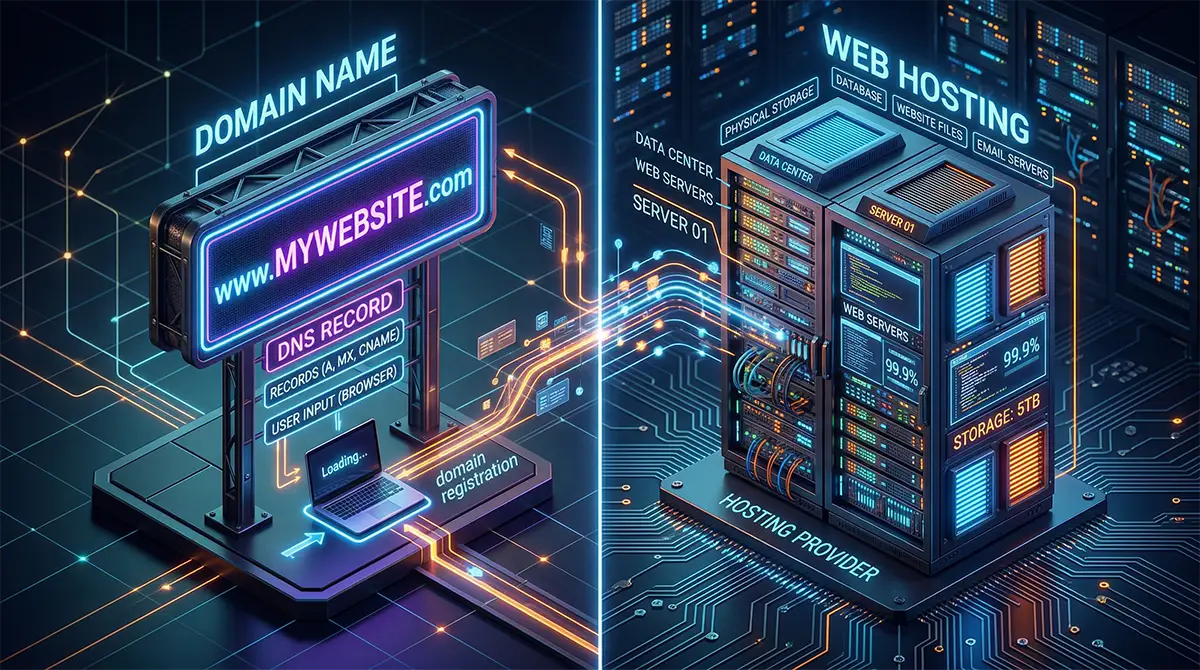
How DNS Records Connect the Two
The Domain Name System (DNS) physically bridges your purchased domain and your rented server. When a user types your startup’s URL, their browser immediately queries a global DNS server. This server scans your specific domain’s routing configuration to locate your hosting provider. You must manually point your domain’s nameservers toward your hosting account’s specific IP address. This critical configuration essentially tells the global internet exactly where your application’s files live. If this complex routing is misconfigured, your entire startup remains completely inaccessible to the public. Founders often prefer keeping their domain registrar and hosting provider on entirely separate platforms. This strategic separation prevents catastrophic vendor lock-in if a single service abruptly fails.
The Strategic Shift to Edge Networks
Modern digital architecture is rapidly evolving beyond traditional, centralized web hosting models. Fast-scaling startups increasingly utilize decentralized edge computing networks to distribute their digital payloads. This approach caches static website files on hundreds of localized servers across the entire globe. Indian users can download data from a nearby Mumbai node instead of a distant server. This drastically reduces critical latency, ensuring near-instantaneous load times for highly demanding dynamic applications. Understanding this architectural evolution is vital for planning a globally scalable technical product.
The Financial ROI of Decoupled Web Infrastructure
Decoupling your domain registration from your hosting provider secures your digital assets against sudden vendor outages. It empowers startup founders to migrate their intensive server workloads easily while strictly controlling their monthly infrastructure costs.
The Hidden Dangers of Vendor Lock-In
Many novice entrepreneurs purchase their domain and hosting in a single, convenient bundle. This seemingly helpful setup often creates a massive, hidden technical liability for growing startups. If your bundled hosting provider suddenly experiences a critical, multi-day data center outage, you panic. Because they also control your domain routing, you cannot easily redirect traffic to a backup server. Your entire business remains completely paralyzed until the specific vendor resolves their internal hardware failure. Decoupling these two vital services ensures you always retain absolute control over your digital routing. You can seamlessly point your domain to a completely new cloud server within minutes.
Navigating Indian Regulatory Compliance
Operating a digital business in India now requires strict adherence to localized data laws. The government has recently prioritized heavily securing the national digital identity framework. An Economic Times CISO report on .IN Domain Reforms highlights this massive national shift perfectly. It details the urgent 2026 e-KYC compliance rules necessary for registering any Indian digital identity. Over four million .in domains are now subject to these rigorous, mandatory verification protocols. Startup founders must explicitly ensure their chosen domain registrar perfectly complies with these new localized mandates. Failing to properly verify your corporate identity can lead to immediate domain suspension by regulatory bodies.
Calculating the Long-Term ROI
Smart infrastructure planning directly impacts a bootstrapped startup’s highly sensitive financial runway. Domains are incredibly cheap, typically costing under a thousand rupees annually for basic extensions. Web hosting, however, represents a highly variable, recurring monthly operational expense. As your application’s user base grows, your monthly server consumption costs will naturally multiply. You must continually optimize your database queries to prevent expensive, unnecessary server load. The Nasscom Trends in Cloud Hosting 2025-2026 report outlines this precise financial optimization strategy. It shows Indian enterprises rapidly adopting serverless hosting to only pay for exact compute time used. Let us break down the standard economic model for decoupled startup infrastructure.
Economic Deployment Analysis Table
| Infrastructure Type | Average Cost (INR) | Primary Strategic Function | Financial ROI Driver |
|---|---|---|---|
| .IN Domain Name | ₹500 - ₹900 (Annually) | Legal brand identity and routing | Secures localized SEO and brand trust |
| .COM Domain Name | ₹800 - ₹1,500 (Annually) | Global identity and routing | Prevents competitors from stealing traffic |
| Basic VPS Hosting | ₹500 - ₹2,000 (Monthly) | Dedicated computing resources | Predictable costs for early-stage apps |
| Cloud Infrastructure | Variable (Pay-as-you-go) | Infinite auto-scaling capability | Eliminates paying for idle server time |

Benchmarking Scalable Hosting Architectures for SaaS
Modern Indian startups require highly elastic server environments to handle unpredictable web traffic spikes. Legacy shared hosting inevitably bottlenecks performance, making advanced cloud solutions and decentralized edge networks the mandatory standard for technical founders.
The Bottleneck of Legacy Shared Hosting
Traditional shared hosting places hundreds of unrelated websites onto a single, heavily congested physical server. They all fiercely compete for the exact same limited CPU power and system RAM. If another website on your specific server experiences a massive traffic surge, your site slows down. This “noisy neighbor” problem is fundamentally unacceptable for a professional SaaS platform or e-commerce store. Bootstrapped founders must avoid this fragile architecture to prevent disastrous downtime during critical marketing campaigns. Your early-stage product requires highly reliable, dedicated computing resources to build lasting consumer trust immediately. This necessitates a rapid transition to more advanced, logically isolated cloud computing environments.
Architecture Alpha: AWS Elastic Compute
Amazon Web Services (AWS) provides the ultimate gold standard for highly scalable cloud computing. It allows technical founders to spin up powerful virtual servers, called EC2 instances, instantly. You only pay for the precise seconds your startup actually utilizes these specific computing resources. This model is exceptionally efficient for applications experiencing highly volatile or unpredictable daily traffic patterns. A comprehensive Go Cloud Architecture Guide from 2026 extensively details this raw computing power advantage. AWS handles complex backend database processing, intense machine learning tasks, and massive file storage effortlessly. It is the absolute optimal choice for the heavy lifting required by complex backend systems.
| AWS Specification | Technical Details |
|---|---|
| Infrastructure Model | Centralized, highly elastic cloud computing |
| Billing Structure | Granular pay-as-you-go per second used |
| Primary Use Case | Heavy database queries and app processing |
| Technical Drawback | Extremely complex configuration learning curve |
Architecture Beta: Cloudflare Edge Delivery
Cloudflare approaches the hosting dilemma from a completely different, highly decentralized architectural angle. Instead of centralizing heavy compute power, it focuses intensely on rapid data delivery. It securely intercepts user requests at the absolute closest geographic point on its global edge network. This specialized network excels at instantly serving static assets like images, CSS, and basic HTML. It massively reduces the computational burden placed entirely upon your primary AWS backend server. It also provides an impenetrable layer of advanced DDoS protection for your fragile new application. Integrating Cloudflare with AWS creates a perfectly optimized, highly resilient hybrid cloud infrastructure.
| Cloudflare Specification | Technical Details |
|---|---|
| Infrastructure Model | Decentralized global edge delivery network |
| Billing Structure | Tiered monthly plans (Generous free tier) |
| Primary Use Case | Static file caching and DDoS mitigation |
| Technical Drawback | Cannot run heavy backend database tasks |
Frequently Asked Questions
01 What is the fundamental difference between a domain name and web hosting?
A domain name is your easily readable digital address on the global internet. Web hosting provides the physical computer servers required to store your website's actual data files.
02 Why do technical founders prefer keeping domain registration and cloud hosting on separate platforms?
Separating them actively prevents total vendor lock-in during a catastrophic server failure. If your host crashes, you can instantly re-route your domain to a completely different backup server.
03 How do DNS records physically connect a .in domain to an AWS or cloud hosting server?
DNS acts exactly like a highly complex digital switchboard. You configure your domain's nameservers to point directly to the specific IP address of your AWS cloud instance.
04 What are the new 2026 NIXI e-KYC regulations for registering an Indian domain?
NIXI now strictly requires rigorous digital identity verification for all new localized domains. Founders must submit official government ID to legally secure and maintain their corporate .in digital address.
05 How does hybrid cloud hosting differ from traditional shared web hosting for a scaling SaaS?
Shared hosting brutally forces your application to share resources with hundreds of random strangers. Hybrid cloud dynamically auto-scales dedicated virtual resources specifically to handle your unique, unpredictable traffic spikes seamlessly.
06 Can I secure a domain name now without paying for a hosting plan immediately?
Yes, you can easily buy and securely reserve a domain name for years beforehand. You only pay for expensive web hosting when you are finally ready to launch your application.